How consensus is decided
Two rules for when a room agrees, and a switch to compare them on the same votes.
"Most people agree" and "everyone agrees" aren't the same thing. The survey's results carry a switch so you can read the same votes under two rules, one after the other.
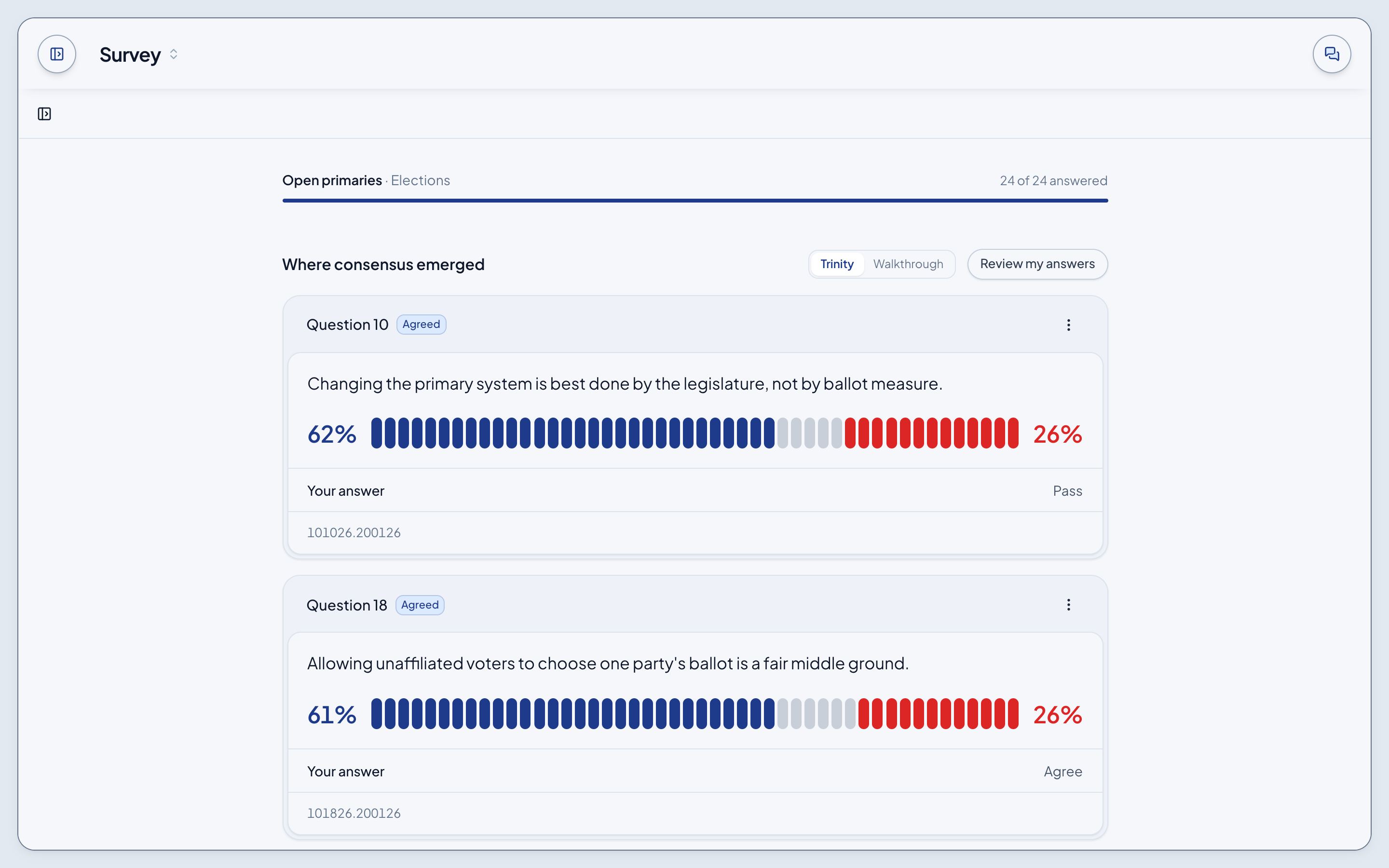
Trinity
Most of the room is on one side, and no opinion group has a majority on the other. A group that merely leans the other way, without a majority, doesn't stop it. It counts consensus either way: to agree, or to disagree.
The results list only the questions that pass, strongest first, each with your own answer.
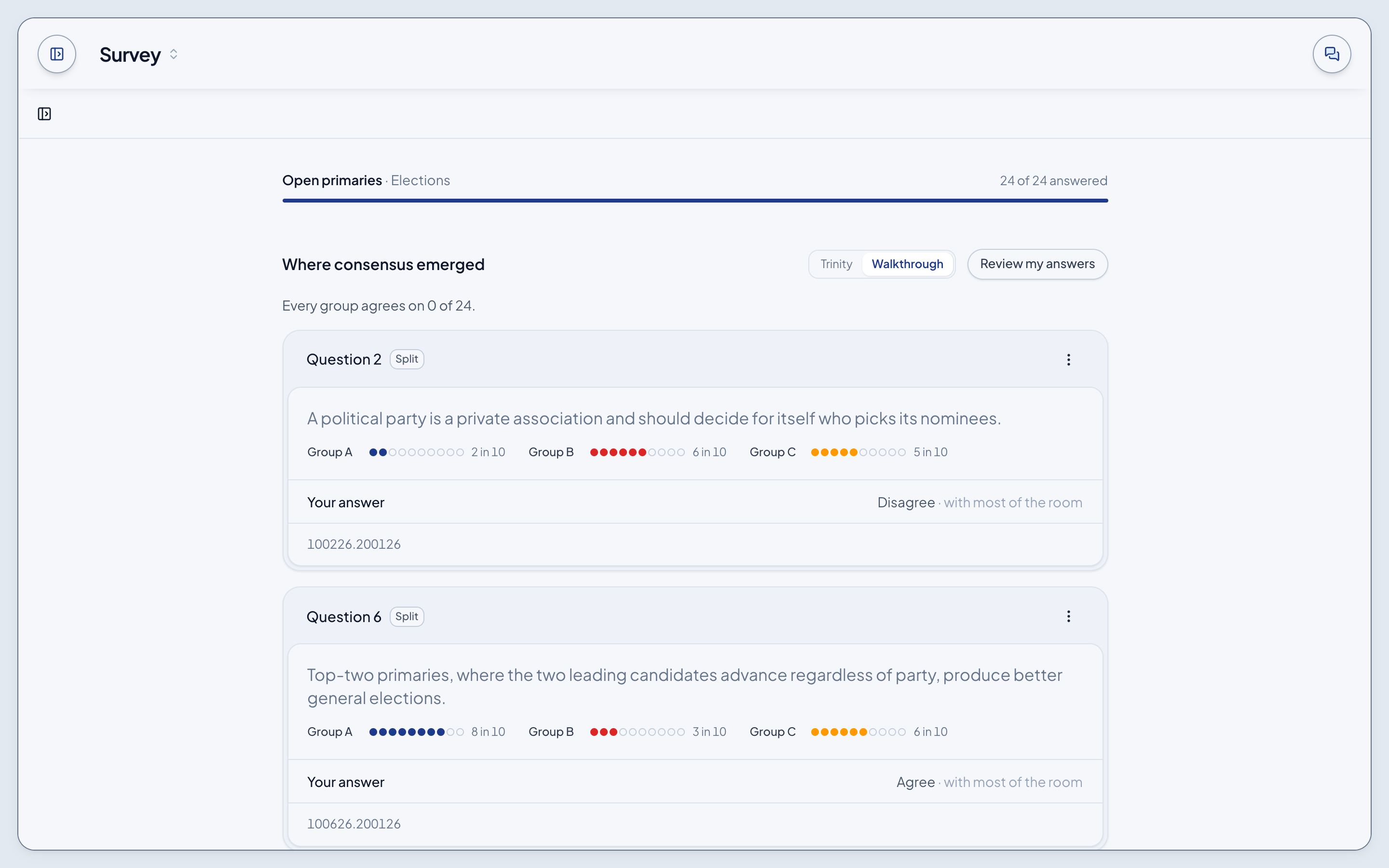
Walkthrough
The rule from the walkthrough on nysgpt's home page: every opinion group has to agree at 7 in 10 or more. The least agreeable group decides, so a big group can't carry a small one. It counts agreement only.
The results list every question, those every group agrees on first, marked Every group agrees (or Both agree, with two groups) or Split. Each group shows as ten people, filled for each who agrees.
Which to use
The Walkthrough rule is stricter, and stricter is more honest about what "consensus" means. It's also slower to find any: with few votes, or a divided room, it can come back empty. On Open Primaries today, no statement clears it; the closest one's least agreeable group is at 38%.
Small groups
A group counts once it has at least five votes on a statement, and a statement needs ten votes before it can show at all.